




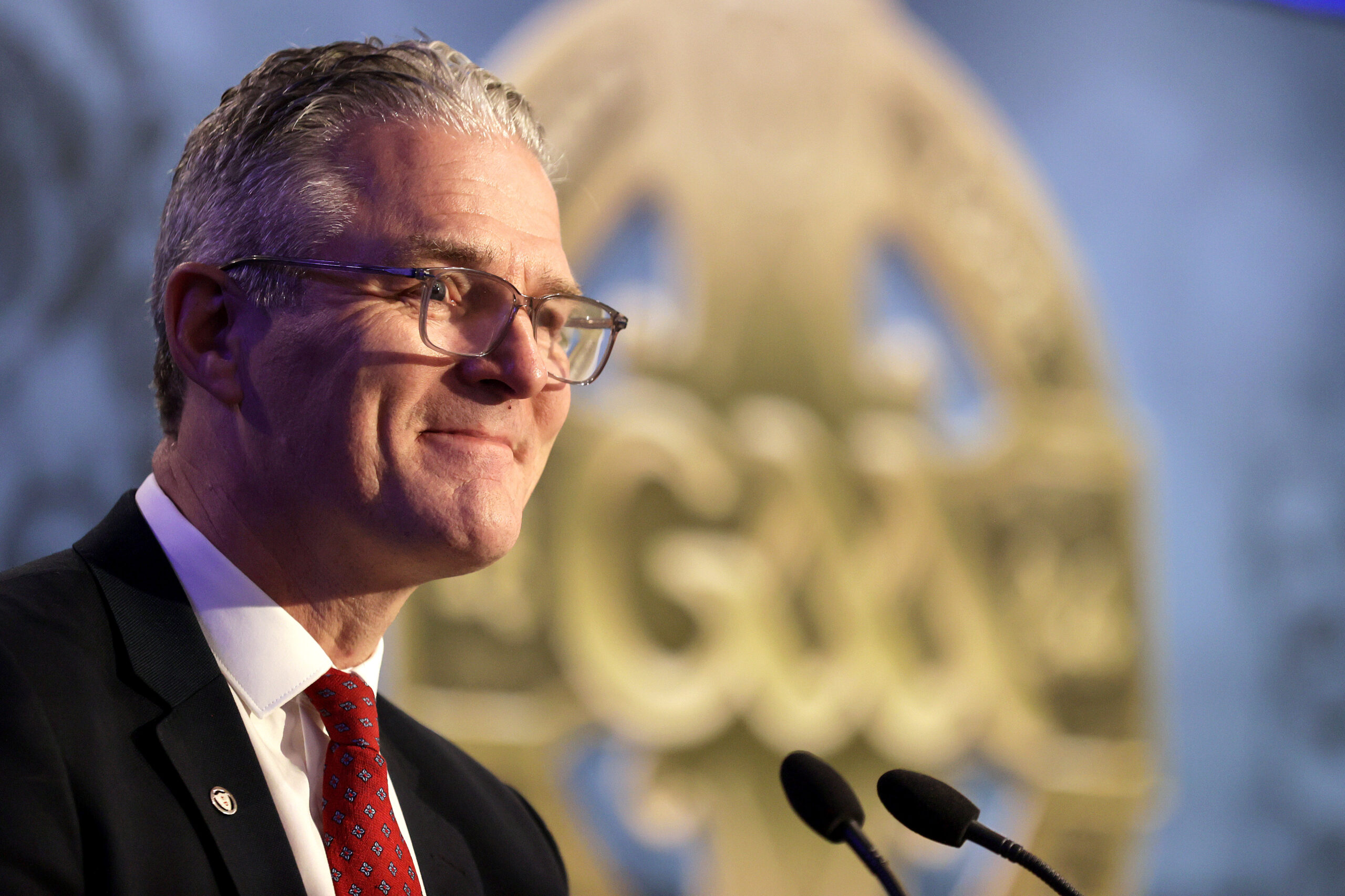
In the pantheon of Gaelic Athletic Association (GAA) presidents, there have been lawyers, teachers, and political fixers. There have been men from the bustling streets of Dublin and the quiet hamlets of Cork. But rarely has the association seen a figure quite like Jarlath Burns. To look at the Armagh native is to see a living paradox: he is a formidable former midfielder who tweets about the “death of football” , a Catholic school principal who marches at Pride and defends integrated education, and a soft-spoken Ulsterman who is unafraid to confront political protestors face-to-face.
Elected as the 41st President of the GAA in February 2024, Burns represents a distinct shift in leadership . He is the first president from Northern Ireland in three decades and the first former senior inter-county player to hold the office since Kilkenny’s Nickey Brennan in 2006 . But his tenure, still in its early stages, has already been defined by bravery: bravery in tackling the sport’s dour tactical evolution, bravery in confronting domestic abuse in the coaching ranks, and bravery in navigating the treacherous waters of international politics and the Middle East conflict.
This is the story of the man from Silverbridge who is trying to save the GAA from itself, one courageous conversation at a time.
Table of Contents
ToggleThe Anchor of the Orchard County
Before the blazers and the official duties at Croke Park, Jarlath Burns was simply the anchor in the Armagh midfield. Born in 1968 in Silverbridge, a small village in South Armagh, Burns was physically imposing—standing at 6 foot 3 inches—and intellectually curious . He made his senior debut for the Armagh county team in 1987, a time when the GAA in the North was still navigating the darkest years of the Troubles.
For thirteen seasons, Burns toiled. He was never an All-Star, and he never lifted the Sam Maguire as a player. But he had grit. His defining moment in the orange jersey came in 1999 when he captained Armagh to the Ulster Senior Football Championship title . It was the county’s first Ulster title in seventeen years, snapping a drought that had plagued the Orchard County. The image of Burns climbing the steps of the Gerry Arthurs Stand to collect the Anglo-Celt Cup remains a nostalgic high point for Armagh fans of a certain vintage, a signpost that foreshadowed the All-Ireland glory that would finally arrive in 2002 (and again, under his son’s watch, in 2024) .
While his playing career was defined by breaking lines, his post-playing career was defined by building bridges.
The Principal: Education Over Indoctrination
Perhaps the most critical training ground for the GAA presidency wasn’t the muddy pitches of Ulster, but the hallways of St. Paul’s High School in Bessbrook. For over 30 years, Burns worked at the school, serving as its principal from 2013 until his election as GAA President . Under his stewardship, St. Paul’s grew into a behemoth of education with over 1,800 students, becoming one of the most oversubscribed non-selective schools in Northern Ireland .
Burns’ philosophy is radical in the context of Northern Ireland’s often rigid sectarian education system. In an interview with The Irish Times, he famously stated, “I’m not against integrated education, but I am for Catholic education” . But his definition of “Catholic education” is surprisingly secular. He argues that Catholic schools are not for Catholics alone—welcoming atheists, Muslims, and Protestants—and that they should be “low on doctrine and high on values” .
His actions speak louder than his words. Burns has built bridges with the Orange Order, inviting them into his school to break down barriers. He defied conservative critics by attending Pride parades after a gay student was assaulted, sending a clear message that his school was a sanctuary of “wonderful diversity” .
He is also an educational innovator. In an era of relentless homework and exam pressure, Burns famously scrapped traditional homework for younger students, prioritizing outdoor play and family time over rote learning . This blend of empathy, logic, and courage defines his leadership style—a style he now brings to the GAA.
The Rules Revolutionary: Saving Football from Itself
If you ask GAA fans what keeps them up at night, many will say the state of the modern Gaelic football game. For years, the sport has been criticized for defensive “blanket” systems, hand-passing cycles, and low-scoring, attritional wars of attrition.
Jarlath Burns was complaining about this long before it was trendy. Back in 2015, watching a dreary Dublin vs. Derry league game that yielded a paltry total of 12 points, Burns tweeted his frustration. He didn’t just call it boring; he declared it “the death of Gaelic football” .
As chairman of the Standing Committee on Playing Rules, he was at the forefront of attempts to fix the game, introducing the kick-out mark and attempting to streamline the chaos . Now, as President, the weight of fixing the game rests squarely on his shoulders.
The Irish Examiner has noted that his presidency is “indelibly linked to the health of Gaelic football” . He enters the role not as a politician making promises, but as a purist who is horrified by what he sees. He has historically pushed back against simplistic fixes, arguing that forcing all kicks forward merely allows defenses to “fill the target area” . Instead, he advocates for a nuanced understanding of space and movement. The expectation is that Burns will use his tenure to rip up the rule book and restore a sense of chaos and scoring to the game—a daunting task that even he acknowledges requires looking at “all the consequences” before acting.
The Controversies: Standing on Principle
The quiet man from Armagh has shown he is not afraid of a fight. Two major controversies have defined the mettle of his presidency so far, demonstrating that he intends to use the moral authority of the office, not just the ceremonial powers.
The Rory Gallagher Affair
Just weeks into his term, Burns faced an explosive situation. Rory Gallagher, the former Derry manager, was lined up for a coaching role with Naas GAA in Kildare. Gallagher had been publicly accused of domestic abuse by his estranged wife—allegations that, while not resulting in criminal charges, had created a media firestorm .
Burns took the unprecedented step of writing directly to the club. He admitted he had no constitutional power to block the hiring, but he wielded his influence like a scalpel. He warned Naas that their reputation was at stake if they proceeded, citing the GAA’s “Game Changer” initiative, which seeks to tackle gender-based violence .
The intervention worked; Naas dropped their interest. Gallagher hit back, accusing Burns of entering an “authoritarian world where due process and procedure count for nothing” . For Burns, it was a calculated risk. He prioritized the GAA’s message on violence against women over the legal loopholes of employment. It was a signal that under his watch, the GAA would not provide a sanctuary for figures whose presence brought the association into disrepute, regardless of court outcomes.
The Storm in Croke Park
Perhaps the most visceral moment of Burns’ presidency occurred during the 2026 GAA Congress. Protestors, angry over the GAA’s sponsorship deal with Allianz (due to the company’s alleged ties to the Israeli military), stormed the stage at Croke Park. Security guards were injured. The protestors screamed at Burns, accusing him of complicity in “genocide” .
Most presidents would have called for security and retreated. Burns stood his ground. In a moment of raw emotion, he invoked his childhood in South Armagh. He referenced the Glenanne Gang—a loyalist paramilitary group—and the murder of his friend Michael Donnelly in the 1975 Donnelly’s Bar massacre .
“I don’t need any lectures about what it’s like to feel the pressure of illegal occupation… that was my lived experience when I was young,” he told the hall . By contrasting the protestors’ tactics with the real violence of his youth, Burns disarmed the interruption and reframed the debate with a moral authority few in the room could claim. He refused to be bullied, defending the GAA’s internal governance processes while acknowledging the pain of the wider world.
A Family Affair: The Sam Maguire Circle
For any GAA fan, the ultimate dream is to see your son lift the Sam Maguire. For Jarlath Burns, it became a reality in the summer of 2024.
His son, Jarly Óg Burns, was a crucial member of the Armagh team that finally broke their long-standing All-Ireland curse. In a beautiful, cinematic twist of fate, it was Jarlath—now serving as Uachtarán CLG—who presented the Sam Maguire cup to the Armagh captain . The image of father and son embracing on the Croke Park pitch, the county’s 21-year wait for glory over, transcended sport. It was a moment of pure, unscripted GAA poetry.
That moment encapsulates Jarlath Burns’ journey. He was the captain who couldn’t quite get over the line in the 90s. He became the educator who shaped a generation. And now, he is the president who handed his son the biggest prize in the sport .
The Vision for the Future
Jarlath Burns is not a president obsessed solely with the elite inter-county game. In one of his first major addresses, he highlighted the “remarkable growth of Rounders” . He sees the GAA not just as a vehicle for winning trophies, but as a community hub. He has spoken of his desire to see Rounders get its own headquarters, showcasing a commitment to the “undergrowth” of the association, not just the “big tree” of football and hurling .
He is also fluent in Irish (Iarlaith Ó Broin) and deeply committed to the cultural identity of the GAA, yet he is pragmatic about the organization’s place in a changing Northern Ireland . He represents a bridge between the traditional nationalist heartland of the GAA and the “new Ireland” that is emerging, one where diversity and inclusion are paramount.
He has stated that “the best leaders are teachers” . In the classroom, he managed children with “barriers to learning” rather than “special needs.” In the GAA, he now manages counties with barriers to unity. Whether it is fixing the football rules, navigating global politics, or upholding the integrity of the amateur ethos, Jarlath Burns is proving that the role of the GAA President is no longer just about cutting ribbons.
It is about moral clarity. And in a noisy, divided world, Jarlath Burns is speaking with a voice that is distinctly, and courageously, his own.