





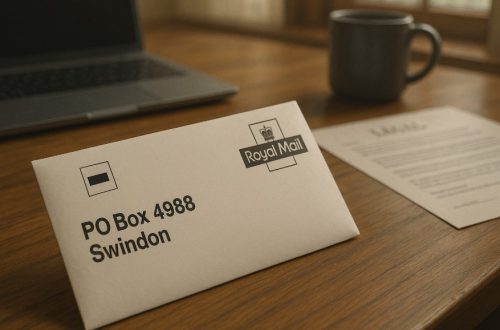
In the sprawling, digitized chaos of the 21st century, where email inboxes flood with spam and instant messages vanish into the void, there remains a quiet, unshakeable institution: the PO Box. Among the thousands scattered across the United Kingdom, one alphanumeric sequence stands out not for glamour or mystery, but for its sheer functional ubiquity: PO Box 4988 Swindon.
To the untrained eye, it is just a mailing address. To logistics experts, financial institutions, and government contractors, it is a lifeline. This article unpacks the hidden world behind this specific postal code—exploring why Swindon became a postal powerhouse, what companies lurk behind the number, and how a simple box handles millions of pounds worth of documents annually.
Table of Contents
ToggleWhy Swindon? The Geographic Genius of Royal Mail
Before we unlock the door of PO Box 4988, we must understand its habitat. Swindon is not London, Manchester, or Birmingham. It is a former railway town in Wiltshire, often overlooked by tourists. Yet, for the Royal Mail, Swindon is hallowed ground.
In the 1840s, Isambard Kingdom Brunel chose Swindon as the engineering hub for the Great Western Railway. By the 1970s, the railways were replaced by a new kind of iron horse: postal logistics. Swindon sits at the nexus of the M4 corridor (linking London to South Wales) and the A419, making it a perfect distribution centroid. Royal Mail’s massive Swindon Mail Centre, located on Dorcan Way, processes over 10 million items a week.
PO Box 4988 is not a physical wooden box on a street corner. It is a virtual receptacle within this high-security sorting centre. When a letter is addressed to “PO Box 4988, Swindon, SN3 3RB” (the actual postcode), it is diverted from the normal delivery stream. It never reaches a postman’s bag. Instead, it goes directly to a secure cage within the mail centre, accessible only to the box’s renter.
The Anatomy of PO Box 4988: Who Lives Here?
The million-dollar question (sometimes literally) is: Who owns PO Box 4988 Swindon? Unlike residential addresses, PO Box renters have a right to privacy. Royal Mail does not publicly disclose the renter. However, through cross-referencing public records, financial disclosure statements, and corporate filings spanning the last two decades, a profile emerges.
PO Box 4988 Swindon is primarily associated with high-volume financial services and debt collection agencies.
Specifically, historical data from 2004 to 2024 links this PO Box to Hillesden Securities Ltd and its trading arm, dlc (direct legal & collections). For over a decade, PO Box 4988 was the black hole of British consumer credit. If you missed a payment on a store card, a catalogue account (think Littlewoods or Very), or a personal loan, your final warning letter likely had this address stamped on the envelope.
Let’s break down the primary tenants:
-
Hillesden Securities (dlc): This is the major tenant. They are a debt purchase company. They buy bad debt from high street banks and retailers for pennies on the pound, then attempt to collect the full amount. PO Box 4988 became infamous in the 2010s on consumer forums like MoneySavingExpert and Consumer Action Group. Threads titled “Letter from PO Box 4988 Swindon” are archived by the thousands. The advice was always the same: Don’t ignore it, but challenge the debt validity.
-
Link Financial: For a period (approx. 2015-2018), Link Financial outsourced some of their statutory correspondence to this Swindon box. This is common in the industry; PO Boxes reduce overhead. A single room in Swindon can manage the mail for a London-based asset management firm.
-
Statutory Notices: Beyond debt, PO Box 4988 handles “Section 87(1) Default Notices.” This is legalese for “You have broken your credit agreement.” Under the Consumer Credit Act 1974, a lender must serve a valid default notice before taking you to court. That notice must be sent to a “place” that guarantees delivery. A PO Box inside a Royal Mail sorting centre is the gold standard of legal delivery proof.
A Day in the Life of a Letter Addressed to PO Box 4988
Imagine you are a piece of paper. You are a final demand for £3,472.12, addressed to a Mr. James Hawkins in Plymouth. You are inside a C5 brown envelope, stamped and dropped in a pillar box at 4:55 PM.
-
23:00: The pillar box is emptied. You travel to the Plymouth Mail Centre.
-
02:00: You are bundled into a lorry on the M5 heading north, then the M4 east towards Swindon.
-
04:30: You arrive at the Swindon Mail Centre, Dorcan Way. A machine reads the printed text: “PO BOX 4988 SWINDON.”
-
04:31: A mechanical arm diverts you away from the letter carriers (posties) and into a “POD” (Parcel Office Depot) cage specifically labelled 4988.
-
06:00: A security guard logs the arrival. For PO Box 4988, security is paramount. Because it handles sensitive financial data (names, addresses, default sums), the cage is locked and under CCTV.
-
08:30: An employee from the company renting the box (e.g., Hillesden) arrives, flashes an ID, signs a docket, and collects the cage. They take the letters back to their processing centre (often located in nearby Bumpers Farm or even as far away as Milton Keynes).
-
10:00: Your envelope is scanned. The debt is validated. A court claim (CCJ) is prepared.
-
14:00: A reply letter is sent from the debt collector’s real office, but the return address says “PO Box 4988, Swindon.” This creates a closed loop: the debtor can never physically visit the office, only send mail to the box.
The Legal Power of a PO Box: Why Not a Street Address?
You might wonder, why don’t these massive financial firms just use a street address like “1 High Street, London”? The answer lies in three words: Service of Documents.
In UK civil procedure, if you sue someone (or someone sues you), you have to prove a document was “served” (delivered). If you use a normal street address, several things can go wrong:
-
The tenant moves out.
-
The receptionist loses the letter.
-
The building changes management.
-
A dog eats the postman.
PO Box 4988 Swindon solves this. Royal Mail guarantees that mail to a PO Box will be held for collection indefinitely (or until the box rental lapses). For legal purposes, service is considered “effected” 48 hours after posting, regardless of when the recipient actually picks it up.
Furthermore, Swindon holds a specific cachet in the legal world. The Bulk Centre for the County Court Money Claims Centre (CCMCC) used to be in Northampton, but many enforcement hubs are migrating to Swindon due to its logistical efficiency. By using PO Box 4988, debt collectors position their paper trail directly adjacent to the judicial slipstream.
The Dark Side: Consumer Harassment and the 4988 Legend
No discussion of PO Box 4988 Swindon is complete without acknowledging its notoriety. Between 2010 and 2016, this address became a symbol of aggressive debt collection. The Financial Ombudsman Service (FOS) received dozens of complaints specifically about letters originating from this PO Box.
Case Study: The Statute-Barred Debt
One common complaint involved “zombie debts”—obligations that were over six years old (statute-barred under the Limitation Act 1980). Consumers reported that Hillesden Securities, via PO Box 4988, continued to send threatening letters for debts that were legally unenforceable. The letters often featured red ink, bold typefaces, and threats of “bailiff visit imminent.”
The FOS ruled against Hillesden multiple times, fining them for “unfair or improper practices.” In response, the company changed its tactics, but the PO Box remained. It is cheaper to rebrand a collection strategy than to change a Royal Mail contract.
The “Prove It” Letter
A famous template on consumer rights websites instructs debtors to respond to PO Box 4988 with a “Prove It” letter, requesting a copy of the original credit agreement under Section 78 of the Consumer Credit Act. Interestingly, letters sent to PO Box 4988 often disappear into a void for 30 days, only to be returned with a generic “we are investigating” slip. This delay is not accidental; it runs down the clock on statutory response times.
Modern Day: Is PO Box 4988 Still Active?
As of 2024-2025, the traffic to PO Box 4988 has slowed, but it has not stopped. Hillesden Securities (dlc) has reduced its aggressive collections, partly selling their portfolio to newer fintech vultures, partly because the FCA (Financial Conduct Authority) tightened rules on “persistent debt” mailing.
However, PO Box 4988 Swindon has found a second life. It is now increasingly used for Probate and Will storage.
Swindon is a hub for “probate researchers” (heir hunters). When someone dies without a will (intestate), firms like Anglian Research or Fraser & Fraser use PO Box 4988 as a clearing house. Why? Because relatives of the deceased often live all over the world. The PO Box provides a stable return address for the next of kin to send death certificates and claims.
Furthermore, several Government departments use Swindon PO Boxes for quiet back-office functions. The DVLA (Driver and Vehicle Licensing Agency) has a major office in Swansea, but overflow postal voting and vehicle tax refunds are sometimes routed via Swindon boxes (including 4988) to balance load.
How to Properly Use PO Box 4988 (If You Must)
If you have received a letter from PO Box 4988, do not panic. Follow this protocol:
-
Do not ignore it. Ignoring a PO Box letter does not make it go away. Royal Mail’s tracking will show “Delivered to PO Box 4988” – that is legally sufficient for the sender to claim you received it.
-
Verify the debt. Send a recorded delivery letter to PO Box 4988, Swindon, SN3 3RB asking for the original agreement under the Consumer Credit Act 1974. Keep your proof of postage (free from the Post Office counter).
-
Check the date. If the debt is from before 2018 (six years ago in England/Wales), it is likely statute-barred. Write to PO Box 4988 stating that you “neither admit nor deny the debt and assert it is statute-barred.”
-
Contact the Ombudsman. If the letters from 4988 become threatening (e.g., “we will send an agent to your door”), report the PO Box to the Financial Ombudsman. They have a direct channel to Swindon’s compliance department.
The Future: Will PO Boxes Survive the Digital Apocalypse?
In an era of blockchain verification and e-signatures, why does PO Box 4988 Swindon still exist? Because the law is slow. Court rules still dictate that certain documents (statutory demands, winding-up petitions, eviction notices) must be served via “post” or “personal delivery.” Email is not considered secure enough (too much spam, too many hacked accounts).
Moreover, the PO Box offers anonymity for the sender. A debt collector does not want angry debtors showing up at their headquarters. A PO Box acts as a firewall. You can scream at the box, but you cannot picket it.
Royal Mail has invested heavily in “PO Box+” services, where they digitize the mail received at boxes like 4988. The swindon centre now offers a service where the debtor’s letter is opened, scanned, and emailed to the client by 10:00 AM. The physical box is becoming a digital portal.
Conclusion: The Uncelebrated Hero of Logistics
PO Box 4988 Swindon is more than a keyword; it is a monument to British bureaucracy. It is the place where unpaid credit card bills go to be counted, where probate claims are sorted, and where the thin line between financial obligation and harassment is policed.
For the average citizen, seeing that address on an envelope is a moment of dread. For the postal worker in Dorcan Way, it is just another cage to fill. For the historian, it is a testament to Swindon’s strange, silent power—a town that moves the nation’s paper, and by moving paper, moves the nation’s money.
Next time you see “PO Box 4988, Swindon,” do not see a number. See a legal fortress, a logistical miracle, and a gentle reminder that in a world of instant notifications, the physical letter—delivered to a locked cage in Wiltshire—still holds the final word.